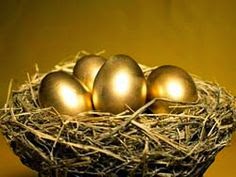
The Cash Flow Statement shows us the inflows and outflows of cash that a business or company made over a period or duration of time, e.g. a year (12 months), a quarter (3 months) or a month.
It shows us how much Cash the business or company generated, where the Cash comes from and how the Cash was spent.
The Cash Flow Statement is probably the most important Statement as a business cannot survive without Cash. Although Profits are important and may usually be the focal point, the core engine behind a business is actually Cash. Cash creates Profits. Profits do not create Cash! As the saying goes - "CASH IS KING!"
The Cash Flow Statement, as its name suggests, is made up primarily of Cash (which is 'obviously' an ASSET).
The Cash Flow Statement is divided into 3 main parts: -
Part 1 - Operating Activities This part shows the cash inflows generated by and the cash outflows used in relation to activities performed as part of the main principal activities or day-to-day operations of the business.
Part 2 - Investing Activities This part shows the cash inflows generated by and the cash outflows used in relation to purchase and sale of fixed assets (e.g. machinery, tools, equipment etc) as well as purchase and sale of investments (e.g. shares in the stock market, bonds, treasury notes etc).
Part 3 - Financing Activities This part shows the cash inflows generated by and the cash outflows used in relation to debt (e.g. loans, bank borrowings) or equity (e.g. cash raised through issuance the company's shares in the stock market).
Here's an example of a Cash Flow Statement.
To wrap it up, here's "All 'Bout the Money" by Meja.
The Profit And Loss Statement (also known as The Statement of Financial Performance or The Income Statement) shows us how much profit or loss the business made over a period or duration of time, e.g. a year (12 months), a quarter (3 months) or a month.
In other words, did the company or business make money or lose money?
The Profit And Loss Statement made up of REVENUE and EXPENSES.
So, here's another equation for you: -
Profit or Loss = REVENUE - EXPENSES
If REVENUE > EXPENSES = Profit!
If EXPENSES > REVENUE = Loss!
Here's an example of a Profit And Loss Statement.
Unlike the Balance Sheet which gives a "snapshot" of ASSETS, LIABILITIES and EQUITY at a fixed point in time, the Profit and Loss Statement gives an overview of the REVENUEand EXPENSE "flows" over a duration of time (just like a river flowing into a lake).
As REVENUE and EXPENSES flow just like a river in The Profit And Loss Statement, let's listen to Billy Joel's "River of Dreams".
The Balance Sheet (also known as The Statement of Financial Position) shows us the position or net worth of the company or business at a particular point in time (e.g. a year, a quarter or a month). A snapshot!
I'm sure I look better without that cowboy hat on!
The Balance Sheet is made up of ASSETS, LIABILITIES and EQUITY, where the elements are presented true to THE ACCOUNTING EQUATION.
If you recall, the ACCOUNTING EQUATION is as follows: -
EQUITY = ASSETS - LIABILITIES
When you spin it around, the following equation is also true...
ASSETS = LIABILITIES + EQUITY
Here's an example of a Balance Sheet.
Remember - The Balance Sheet is always in balance, and never out of balance. In other words, there should be no differences arising.
Let's allow The Wallflowers to solidify this with a song called "The Difference".
You may have heard of something called "Financial Statements".
If you ever wondered how a company or business is doing financially, how well or profitable it is, or how healthy it is then the Financial Statements is a good place to start.
They show you how well the money of a company or business is managed, where the money came from, how the money was spent and where the money is now.
In a nutshell, they "SHOW YOU THE MONEY!!!"
There are 3 main Financial Statements, let's call them the "BIG 3".
They are:
1. The Balance Sheet
2. The Profit and Loss Statement
3. The Cash Flow Statement
If you recall the 5 Accounting Elements in the earlier posts, the Elements "live" inside these Statements. Think of each of the Statements as a "house" and the Accounting Elements as its "bricks".
1. The Balance Sheet contains ASSETS, LIABILITIES and EQUITY.
2. The Profit and Loss Statement contains REVENUE and EXPENSES.
3. The Cash Flow Statement contains only CASH (which is actually an ASSET).
We'll talk more about each of these statements in detail later on but in the meantime, let's listen to a song called "Money" by Pink Floyd.
Once upon a time, there was a young boy named Jack who lived with his mother in the countryside. They owned a cow which was their only source of income.
Mooooo!!!
1. Revenue from sale of goods The cow's milk was sold in the market for cash. Jack sold $50 worth of milk a day.
Note: To record this transaction, just run through the 5 Questions introduced in the previous "Double Entry Accounting" post.
The 5 Questions: 1. What items are involved? 2. Which team are they on? 3. Are the teams Debit or Credit in nature? 4. Do the items increase or decrease? 5. Do we Debit or Credit the item?
2. Purchase of fixed asset
Timmmberrrrr!!!
With the money, Jack bought a new axe for chopping firewood. The axe is a Fixed Asset and it cost him $20. It was expected to last him for 4 years.
3. Depreciation of fixed asset One year passed and as Jack used his axe, the axe had depreciated by 1/4th of it's value. So depreciation expense for the first year was $5.
4. Exchange of assets
Aren't they pretty? Please can I keep them?
One day, his cow stopped producing milk. Jack's mother told Jack to go to the market to sell his cow. Instead, Jack exchanged his cow for some "magic beans". His cow was worth $80 to him.
Note: No cash was involved as it was considered a "barter" trade or exchange of goods!
5. Write-off of assets Jack's mother was furious as he had wasted the cow on some "useless" beans. She threw the beans out of the window. The beans were written-off or "expensed".
Overnight, a gigantic beanstalk grew. Jack climbed the beanstalk until he reached a castle in the sky.
The air up here is a bit thin, isn't it?
There, he meets a Giant.
Helloooo!!!
6. Borrowing money He borrowed $200 from the Giant, which he needs to repay 3 months later
7. Purchase of stock
Quack!
Jack saw the Giant's golden goose (which laid golden eggs). Using the cash borrowed, he bought 10 golden eggs at $3 each to sell the market. The eggs were considered as Jack's stock or inventory.
8. Sale of stock
Oh, I can't decide! Sunny side up or scambled?
He sold 8 golden eggs in the market for cash. Each egg was sold for $5.
Note: There are 2 entries here! One affects REVENUE, the other one affects EXPENSES.
Entry 1 - REVENUE
Entry 2 - EXPENSES
The 8 eggs that Jack sold had a cost of $3 each. This was an Expense to Jack. His "Cost of goods sold" was $24.
You may notice that the total PROFIT made on the sale was $16. This is calculated as the difference between the REVENUE of $40 and EXPENSES of $24.
9. Paying worker's wages
So, we are selling flowers right?
As selling eggs was too much for Jack to handle alone, he employed a worker to assist him. He paid the worker $10.
10. Repayment of borrowings
He used the cash from the sale of the golden eggs to pay back a portion of the borrowings to the Giant. Jack generated $40 from the sale of the 8 eggs at $5 each.
One day whilst the Giant was asleep, Jack steals the golden goose and the Giant's harp.
While trying to make a quick getaway, Jack drops the harp and awakens the Giant. Jack runs and climbs down the beanstalk, golden goose in hand.
The Giant chases but before he reaches the ground, Jack uses his axe to cut down the beanstalk, causing the Giant to fall to his death.
Hmmm...Not a bad view from up here...
Jack and his mother became rich selling golden eggs in the market…
...and they lived Happily Ever After!
Summary:
Sooooo...what does it all mean? Is Jack better-off or worse-off?
Question: How much Cash does Jack have left in his pocket?
Answer: $190
Workings:
Bear in mind that Cash is an ASSET. When ASSETS increase, we DEBIT, when ASSETS decrease we CREDIT.
Question: How much is Jack's axe worth after he's used it for one year?
Answer: $15
Workings: Bear in mind that the axe is an ASSET. When ASSETS increase, we DEBIT, when ASSETS decrease we CREDIT.
Question: How much sales did Jack make?
Answer: $90
Workings:
Bear in mind that Sales is REVENUE. When REVENUE increases, we CREDIT, when REVENUE decreases we DEBIT.
Question: How much stock did Jack still have left? Answer: $26
Workings:
Bear in mind that Stock is an ASSET. When ASSETS increase, we DEBIT, when ASSETS decrease we CREDIT.
Question: How much did Jack still owe the Giant?
Answer: $160
Workings:
Bear in mind that Borrowings is a LIABILITY. When LIABILITIES increase, we CREDIT, when LIABILITIES decrease we DEBIT.
Did that make sense? Yes?
Good!
Are you starting to see how Accounting helps Jack keep track of the value of his Accounting "Elements" i.e. ASSETS, LIABILITIES, REVENUES?